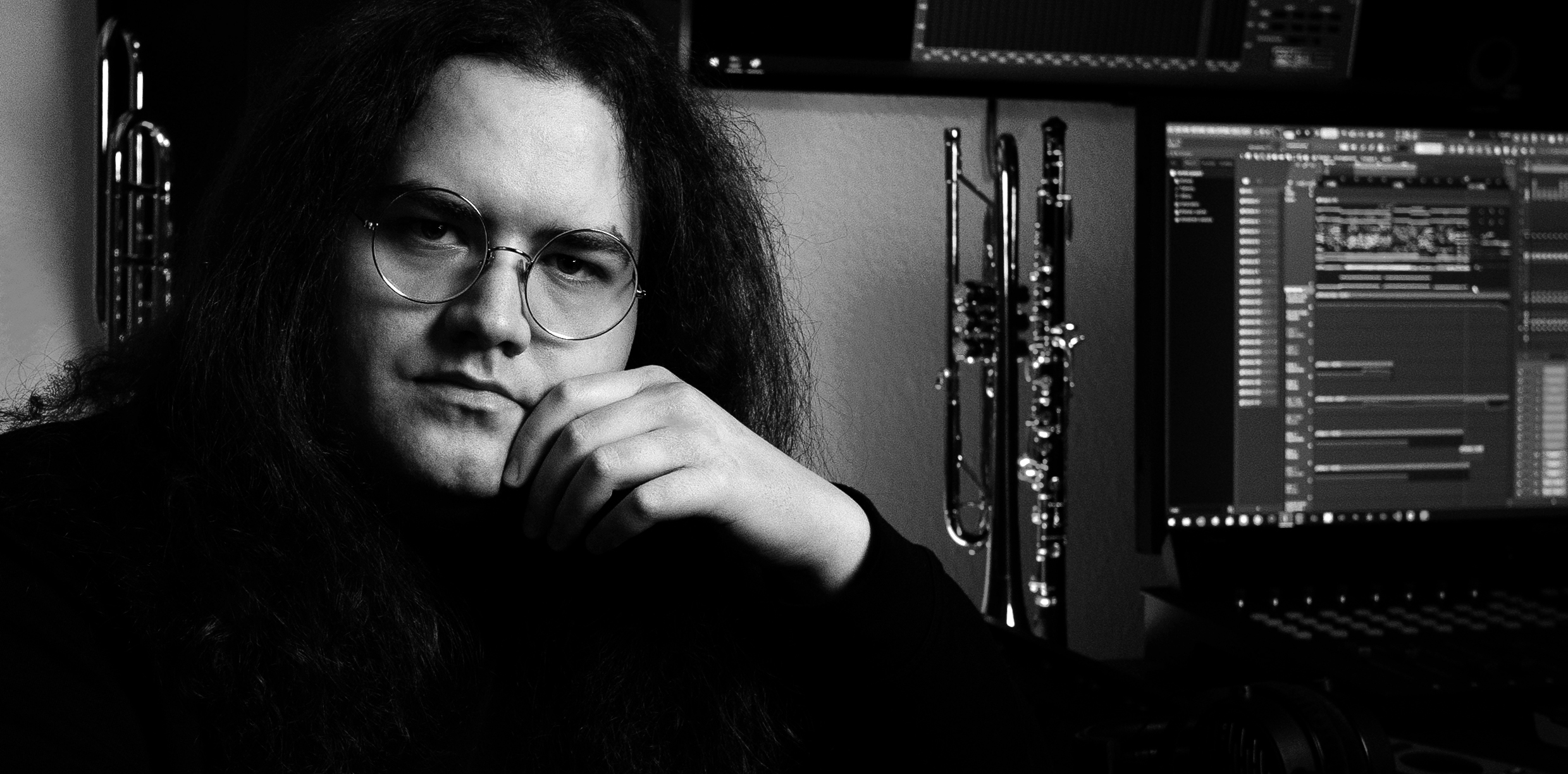
D. A. Edwards (*1997, Germany)
I grew up in a musical family. My parents both being professional musicians, I was exposed to a lot of different music very early on and was able to experiment with the instruments we had at home. From the very beginning, I wanted to figure out music on my own, which my parents allowed me to do by providing the resources they could and without pushing me to learn music in a more traditional way. I’m very thankful that they did it this way because it allowed me to shape my own understanding of music, and my own musical language entirely.
People are often surprised when they find out that I have never studied music, music theory or composition, because my music does, in many cases, follow ideas one would expect from such an education.
But to me, music is simply a very logical thing – like the rules of physics in our universe. The theories written in books are merely trying to explain phenomena in music, which I believe are real observable things – Like dropping an apple and realizing something about our environment.
When I was younger, I was fascinated by and wanted to learn how to play all sorts of different instruments, and I would often start with great enthusiasm, only to stop shortly after I had figured out the basics of an instrument I started to learn, because it wasn’t ever about mastering them or playing pieces by other composers – for me it was all about getting to know them from the inside out. I now recognize that this was probably the way a composer’s brain explores the world. I wasn’t trying to become a performer – I was researching. Learning what an instrument can do, what it feels like to hold and play, how it breathes and responds. And this tactile knowledge became a kind of internal library I still draw from today every time I compose.
Today, that curiosity has grown into a large and still expanding instrument collection. I have at least one instrument from each instrument family, and while I wouldn’t want to hear myself in concert on any of them, it allowed me to develop a good feel for how different instruments work. And that sense of connection to each instrument and its sound production and mechanism is immensely important to me when composing – telling stories with music and painting worlds with the colors and textures of the instruments.
Since the beginning, I have experienced music very visually and perceived imagery and colors when listening to or imagining music, so music and film to me are the perfect combination of arts which I have always been fascinated by. My interest has always been to create my own music – my own imagery, and so for a long time during my teenage years, I was most interested in filmmaking. My internship and several years of work at a local TV studio allowed me to explore this love for camera and lighting, and the dream of becoming a cinematographer one day.
I believe this time has allowed me to gain a unique understanding as a composer of the industry and the many artistic, technical, and logistical aspects of a film production.
During this time, I also began experimenting with electronic music and music programming. Though at first with the limited capabilities of the software I used at the time, as I figured out more things and my demands and resources grew, my experiments on the computer slowly but surely evolved into creating digitally produced orchestral music.
Finally, I was able to bring my imagination of classical and orchestral music into reality, which then allowed me to expand on my ideas even further. At this point I realized that cinematography was not letting me fully explore my creativity, and that music was actually the source behind the visuals I imagined, which turned out to be my preferred way of telling stories and exploring emotions and imagery.
To this day, my music is ever evolving and changing, and I continuously refine my ideas and musical vocabulary.